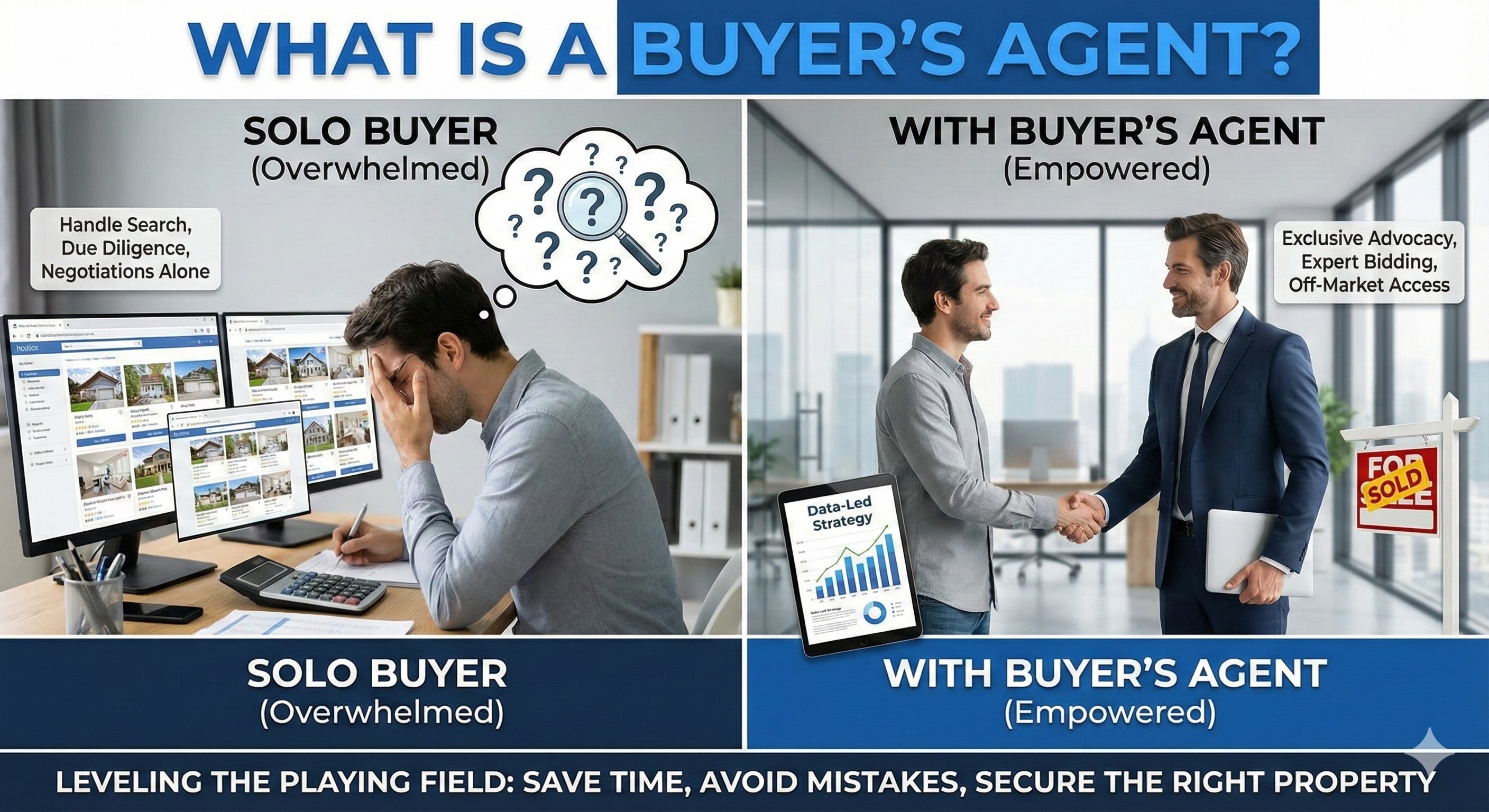

If you’ve ever tried to buy property, you’ve probably felt this:
Spending weekends driving from open home to open home
Refreshing real estate portals at midnight
Being told “there’s a lot of interest” (every. single. time.)
And realising that every agent you talk to… actually works for the seller.
It’s no surprise many buyers feel outgunned.
That’s where buyer’s agents come in.
In this article, we’ll break down in plain English:
What a buyer’s agent is
How they’re different from a traditional real estate (selling) agent
What they actually do day-to-day
Who should consider using one
How they charge fees
How to choose a good one (and avoid the dodgy ones)
So… What Exactly Is a Buyer’s Agent?
A buyer’s agent (also called a buyer’s advocate) is a licensed real estate professional who works exclusively for the property buyer, not the seller.
Their job is to:
Search for properties
Evaluate them
Negotiate or bid at auction
And help you secure the right property on the best possible terms
Westpac describes a buyer’s agent as a property-buying professional who specialises in searching for, scoping out and evaluating properties, then negotiating or bidding at auction on your behalf.
Industry bodies like REBAA (Real Estate Buyers Agents Association of Australia) and other professional guides say the same thing: buyer’s agents do not sell property; they specialise in searching, locating, evaluating and negotiating for buyers only.
Put simply:
A selling agent represents the vendor.
A buyer’s agent represents you.
Buyer’s Agent vs Selling Agent: Who’s On Whose Side?
This is the most important distinction – and the most misunderstood.
Selling Agent
Hired and paid by the vendor (seller)
Their legal duty is to achieve the best price and terms for the seller
They market the property, run open homes, handle enquiries, and manage offers/auction
Buyer’s Agent
Hired and paid by you – the buyer
Their legal duty is to act in your best interests
They help you:
Find suitable properties
Assess value and risk
Negotiate or bid
Avoid overpaying or buying the wrong thing
By law, in Australia an agent cannot act for both parties in the same transaction and take a commission from both sides.
So you essentially have a choice:
Let the seller have a professional negotiator on their side
Or hire one of your own.
What Does a Buyer’s Agent Actually Do?
Depending on the level of service you choose, a buyer’s agent can help with some or all of the buying process. Common responsibilities include:
1. Clarifying Your Brief
Before looking at any property, a good buyer’s agent will sit down with you to understand:
Budget and borrowing capacity
Preferred suburbs or areas
Property type (house, unit, townhouse, development site, etc.)
Non-negotiables (schools, commute, land size, yield targets)
Time frame and long-term goals
This turns a vague idea (“I want something in the inner west”) into a clear search brief.
2. Researching and Shortlisting
Buyer’s agents spend their days in the market. They:
Constantly scan online listings
Speak with selling agents about off-market and pre-market opportunities
Use data tools, suburb reports and recent sales to identify value
They then send you a shortlist of properties worth considering – not every single listing that appears online.
3. Inspecting and Evaluating Properties
Depending on your engagement, your buyer’s agent may:
Inspect properties on your behalf
Provide photos/videos and objective feedback
Highlight both upsides (location, potential, upside in value) and downsides (noise, overshadowing, flood risk, poor layout)
They should also give you a sense of:
Likely selling price range based on comparable sales
How each property fits your goals (home or investment)
Potential rental yield or renovation value-add
4. Coordinating Due Diligence
A buyer’s agent doesn’t replace a conveyancer or building inspector, but they can help you:
Decide which properties are worth spending money on for reports
Order building, pest or strata reports
Liaise with professionals (solicitor/conveyancer, broker, inspectors)
Keep everything moving so you don’t miss out because you were too slow
Government consumer guides note that buyers’ agents can coordinate searches, appraisals, dealing with vendor agents, and arranging inspection reports as part of their service.
5. Negotiating the Deal
This is where many buyers feel out of their depth.
A buyer’s agent can:
Advise on fair value and a sensible price range
Help you decide on offer structure (price, conditions, timing, deposit)
Negotiate directly with the selling agent
Keep you from bidding against yourself or revealing your maximum too early
Because they negotiate regularly, they’ve seen most tricks and tactics before – and know how to respond logically rather than emotionally.
6. Bidding at Auction
If the property is going to auction, your buyer’s agent can:
Attend and bid for you
Use pre-planned bidding strategies
Stay calm under pressure and stick to your pre-agreed limit
Many agencies offer auction bidding as a standalone service for buyers who can find properties themselves but hate (or fear) auctions.
7. Accessing Off-Market and Pre-Market Properties
One of the big value-adds of a good buyer’s agent is access to:
Off-market properties (never advertised publicly)
Pre-market properties (shown to select buyers before going live online)
They get these opportunities because they build relationships with selling agents who want a quick, clean sale for their vendor, often without the cost and stress of a full campaign.
For buyers, this can mean:
Less competition
More genuine price conversations
A chance to secure the right property before it turns into a bidding war
Is a Buyer’s Agent Just for Rich Investors?
Not at all.
Buyer’s agents work with:
First-home buyers who feel overwhelmed by the process
Time-poor professionals who don’t have the bandwidth to spend every weekend at inspections
Upgraders/downsizers looking for a family home or lifestyle change
Interstate or overseas buyers who can’t be physically present to inspect multiple properties
Property investors wanting data-led decisions and portfolio growth
The common thread is not “richness” – it’s people who understand the cost of getting it wrong:
Overpaying by $50k–$150k
Buying in the wrong street or wrong pocket of a suburb
Missing critical issues in the contract or building report
Taking 12–18 months to buy and watching the market run away from them
Recent articles highlight that buyer’s agents are often helping buyers avoid costly mistakes in fast-moving markets like Sydney, where waiting too long or misreading the market can price you out altogether.
How Do Buyer’s Agents Charge?
Fee structures vary by agency and by service, but common models include:
Fixed fee – A set dollar amount for a defined scope (e.g. full search and acquisition, or auction bidding only)
Percentage-based fee – A percentage of the purchase price (often with a minimum fee)
Tiered packages – Different levels of service:
Full-service (search, shortlist, due diligence, negotiation/bidding)
Negotiation-only (you find the property; they handle valuation & negotiation)
Auction bidding-only
Advisory or “second opinion” on value
Important points:
The buyer pays the fee.
A genuine buyer’s agent does not take commissions from selling agents or developers for the same transaction – that would create a conflict of interest.
Always ask clearly:
“Who pays you?”
“Do you ever receive referral fees, kickbacks or sales commissions from anyone else?”
Pros and Cons of Using a Buyer’s Agent
Like any professional service, there are upsides and trade-offs.
Potential Benefits
Save time – No more aimless open-home hopping
Better decisions – Data, comparable sales and market insight
Less stress – Someone managing the process and deadlines
Stronger negotiation – An experienced negotiator in your corner
Access to more properties – Including off-market and pre-market deals
Risk reduction – Better due diligence, fewer surprises after settlement
Potential Drawbacks
Cost – You pay a fee on top of all the normal buying costs
Quality varies – Not every buyer’s agent is equal; some are exceptional, some are average
Not magic – They can’t change bank valuations, rewrite your borrowing capacity or control the entire market
The key question is not “Is a buyer’s agent good or bad?”
It’s: “Will working with the right one save me more money, time and stress than their fee costs?”
How to Choose a Good Buyer’s Agent
If you decide to explore working with a buyer’s agent, here’s what to look for:
1. Proper Licensing
Check they hold the correct licence in the state where you’re buying
Many state governments provide online licence lookup tools (e.g. NSW Fair Trading register)
2. Independence
Ask directly if they:
Accept any commissions from sellers, developers or project marketers
Or only ever get paid by buyers
Ideally, they act only for buyers and never list or sell property themselves.
3. Local Expertise
Do they specialise in specific suburbs or broader regions?
How many purchases have they made there in the last 12–24 months?
Can they talk in detail about:
Good vs bad streets
School catchments
Flood zones, flight paths, upcoming infrastructure
4. Track Record and References
Ask for:
Recent case studies
Testimonials
Referrals from past clients
Good agents are proud to show you what they’ve achieved.
5. Clear Scope and Fees
Make sure you understand:
Exactly what’s included (search? inspections? due diligence? negotiation?)
What’s not included (legal fees, building reports, bank valuations)
How and when you pay (upfront retainer? success fee on exchange?)
6. Fit and Communication Style
You’ll be working closely with this person through a big financial decision. Ask yourself:
Do they listen more than they talk?
Do they explain things clearly?
Do you feel pressured, or supported?
If something feels off now, it will only feel worse halfway through a tricky campaign.
Do You Need a Buyer’s Agent?
You don’t have to use a buyer’s agent to buy property.
Plenty of people buy on their own and do well, especially if they:
Love research
Have time to attend many inspections
Understand market data
Feel comfortable negotiating and bidding under pressure
But if you’re:
Time-poor
Overwhelmed
Buying in an unfamiliar area
Or simply want someone experienced on your side
…then a buyer’s agent can shift you from reactive and stressed to strategic and supported.
Instead of being the only non-professional in the negotiation, you can put a professional in your corner too.



Similar articles
Related Article

Dec 17, 2025
Off-Market Property in Sydney: Secrets, Myths & What’s Actually True
Jon D'Souza
Read Article
Dec 9, 2025
Stop Spending Every Weekend at Open Homes: A Smarter Way to Buy in Sydney
Jon D'Souza
Read Article
Dec 9, 2025
Too Busy to Buy? How Professional Couples Still Win in Sydney’s Property Market
Jon D'Souza
Read Article
Dec 9, 2025
Time, Money, Stress: The Three Costs JD Buyers Agents Removes for Home Buyers
Jon D'Souza
Read Article

Dec 9, 2025
NSW’s Underquoting Crackdown: What It Really Means for Home Buyers
Jon D'Souza
Read Article